

Mini-Bee: Hybrid VTOL for Humanitarian & Emergency Missions
A lightweight, modular aircraft concept designed to reach people fast—where roads, runways, or helicopters are not available.
What is Mini-Bee?
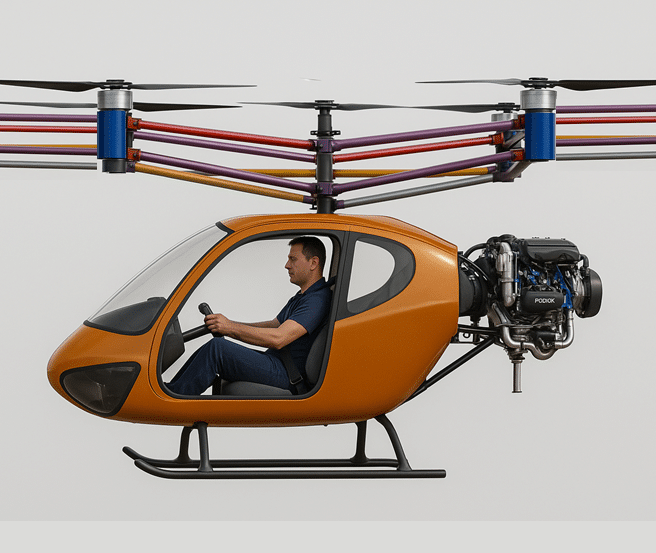
Mini-Bee is a next-generation hybrid VTOL multicopter developed for rapid medical evacuation and emergency response. It aims to combine vertical take-off and landing with lower operating complexity than traditional light helicopters, while improving safety through distributed propulsion.
The current demonstrator stage is TRL 4, coordinated by Technoplane SAS, with humanitarian mission focus supported by RED VTOL ONG and technical support from Alten Solidaire. The project follows the Lesser Open Bee License 1.3 and is documented on an open collaboration wiki.

Why it matters on the field
- Rapid access: VTOL capability enables landing close to the incident area without runway infrastructure.
- Designed for emergencies: prioritizes quick dispatch, straightforward logistics, and mission-oriented equipment integration.
- Redundancy: distributed rotors increase tolerance to a single-rotor failure scenario (with safety strategy including parachute approach).
- Deployable logistics: modular packaging concept compatible with LD3 containers for rapid deployment and assembly on site.
Technical overview (reference configuration)
Mini-Bee is an ultra-light hybrid VTOL multicopter built around a modular composite/tubular structure. The reference configuration includes 18 distributed rotors (updated summer 2025) to enhance redundancy and stability.
- Seats: 2 (1 pilot + 1 passenger)
- Propulsion: Rotax 916 iS (160 hp) with hybrid-electric chain (high-voltage electric machines and energy buffering)
- Cruise: ~160 km/h
- Target range: ~450 km
- MTOW: ~700 kg
- Cruise power: ~100 kW
Flight and control architecture is designed around computerized flight control (FCU), pilot joystick control and assisted modes, with mission-grade monitoring and safety features adapted to emergency operations.
Open collaboration
Mini-Bee is built through an open-innovation approach: academia and industry partners can contribute to design, test benches, flight-control electronics (STM-based FCU), safety studies, and documentation. The goal is to accelerate a credible path toward operational readiness for humanitarian use.
FAQ
Is Mini-Bee certified today?
Not yet. The project is currently at demonstrator level (TRL 4) and is structuring a certification path aligned with EASA frameworks (CS-27 and SC-VTOL-02).
Why 18 rotors?
Distributed propulsion improves redundancy and control authority. It supports safe handling strategies in case of a single-rotor issue, with a safety approach that also considers parachute use.
How can partners contribute?
Contributions are welcome via the public wiki: engineering, documentation, test benches, avionics/FCU development, mission integration, and operational feedback for humanitarian deployment.